Gem Reference › Learn › Jade Appraisal in Singapore
Jade Appraisal in Singapore
What a jade appraisal actually establishes, which laboratories do it, and why treatment grade decides the number
Singapore sits in the middle of the world's jadeite trade: the finest material is mined in Myanmar, cut in Guangzhou and Hong Kong, and sold across Southeast Asia, including here. When a jade bangle or pendant goes for appraisal, the appraiser is answering three questions before any value is discussed: which material is it, has it been treated, and how good is it within its grade.
What a jade appraisal establishes
Two different stones are both sold as jade: jadeite (the imperial-green pyroxene, refractive index about 1.66, specific gravity about 3.3) and nephrite (an amphibole, tougher, usually darker green to white, RI about 1.62, SG 2.9 to 3.0). They can look similar to the eye and are separated decisively by refractive index and specific gravity. The appraisal records which one you have, because imperial Burmese jadeite is the precious material.
Then comes treatment. The Type A/B/C labels describe treatment, not quality:
- Type A: natural jadeite, untreated except classic wax polishing. The collector's stone.
- Type B: bleached and polymer-impregnated. Acid bleaching removes stains, polymer fills the fractures; translucency looks flattered at first and degrades over years.
- Type C: dyed. Colour is artificial; often also bleached (B+C).
A-grade and B-grade jadeite can sit side by side in a display at similar prices, and the difference is tens of thousands of dollars. That is the practical case for appraisal: the letter decides the value.
Who appraises jade in Singapore
- Far East Gem Lab (gemlab.com.sg, established 1988) examines gems and jewellery and prepares valuations for insurance, legacy planning, museum donations and legal matters.
- Raffles GemLab (rgl.com.sg) specialises in Type A Burmese jadeite; dealing in certified untreated material is its identity.
- NGI (Nan Yang Gemological Institute) and other local laboratories also test and certify jade.
Our Singapore gem labs guide profiles each laboratory. Our companion guide, How to Identify Jade, covers the tests themselves in depth.
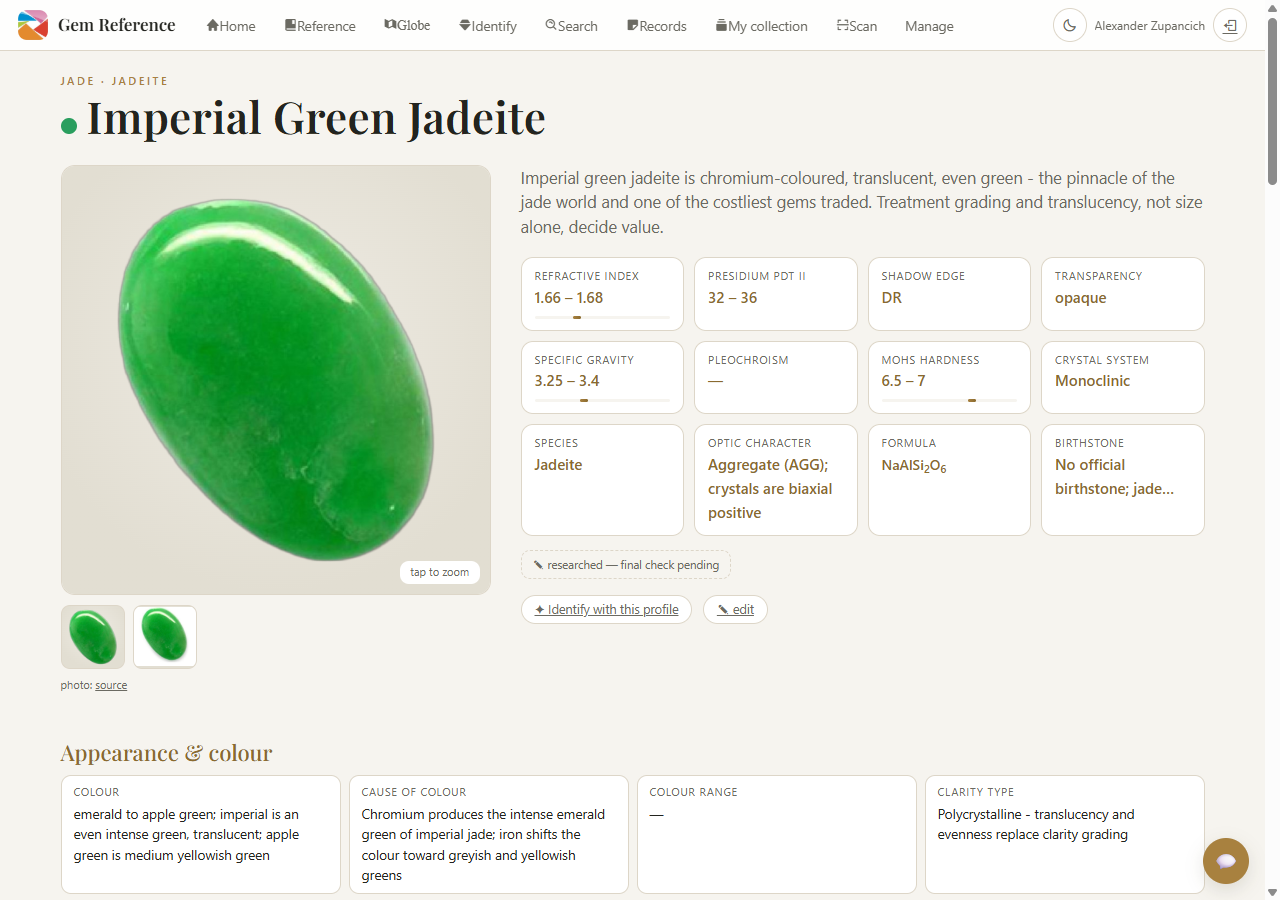
Imperial Green Jadeite in the gem reference database: refractive index (1.66) and specific gravity (3.25) are the entries an appraiser verifies.
Learning to read jade yourself
The instrument workflow behind every jade verdict, refractometer, specific gravity, magnification of polymer in fractures, is taught from first principles in JDMIS's GT200 Gem Identification Methods course, with hands-on practice across up to 100 gems. GT100 Gem and Jewellery Trade Secrets covers the value factors and trade practice that turn a test result into a price. Between them sits the working skill the appraisal counters charge for: knowing what the letter on the certificate implies about the number on the tag.
Common questions
What does a jade appraisal cost or include in Singapore?
Appraisal fees vary by laboratory and purpose; what the appraisal includes is standard: material identification (jadeite or nephrite), treatment determination (Type A, B or C), and a valuation scoped to a stated purpose such as insurance. Ask the laboratory what purpose the valuation will be written for before commissioning it.
Is Type A jade always more valuable?
Type A means untreated, which is the collector's grade, but value still depends on colour, translucency and workmanship within that grade. A modest Type A piece can cost less than a fine B+C imitation asks for, which is exactly why independent testing matters.
Can jadeite and nephrite be told apart without instruments?
Reliably, no. They overlap in appearance; refractive index (about 1.66 versus about 1.62) and specific gravity (about 3.3 versus 2.9 to 3.0) separate them decisively, which is instrument work.
Learn this properly — gemmology at JDMIS, Singapore
Everything on this page is taught hands-on at JDMIS with real stones:
- Gemmology: Secrets of the Gem & Jewellery Trade (GT100) — covers gem value factors and trade practice for jade and every other commercial stone
- Gem Identification Methods (GT200) — hands-on instrument work: refractometer, specific gravity, microscope and UV, the way professionals actually identify stones.
Free tools while you read: Gem Globe (where stones come from) · Name That Gem (test your eye) · our guide to every Singapore gem laboratory.
Educational content by the gemmology faculty of the Jewellery Design & Management International School (JDMIS), Singapore. Gemmological constants quoted are standard reference values.