Gem Reference › Learn › Jeweller's loupe guide
The Jeweller's Loupe, Explained
Ten times magnification, where every identification begins
The 10x loupe is the international standard for grading and evaluating gemstones: clarity grades are defined by what is, and is not, visible at ten times magnification. Every working gemmologist carries one, and every identification sequence starts with it, because most imitations die at the loupe before any instrument is opened.
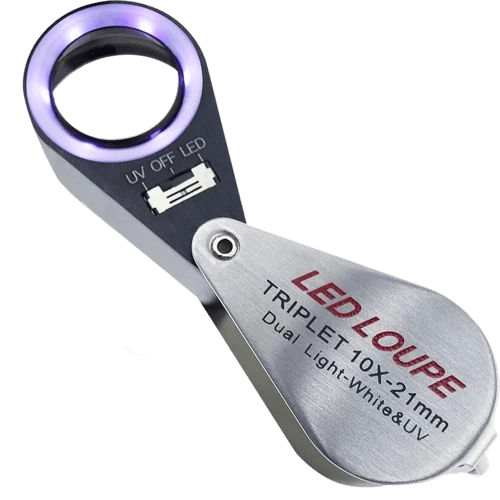 The 10x triplet loupe: three lenses cemented into one corrected system.
What you are actually looking at
The instrument is simple: a triplet, three lenses cemented together, corrected so colours do not fringe at the edges and straight lines stay straight. The skill is all in the interpretation. With the stone steady against the lens and light coming from the side, ten-times magnification shows:
| What you see | What it can mean |
|---|---|
| Inclusions, crystals, feathers, growth lines | Evidence of natural growth; some inclusions name the species outright |
| Fraction vs cleavage breaks | How the stone will behave under pressure, and hints of treatment |
| Doubling of facet edges or back-facet dots | Doubly refractive material, corundum, zircon, and their imitations |
| Glue lines, foil backings, coloured joints | Assembled stones, doublets and triplets |
| Wear patterns, pits, rounded facet edges | Glass and soft imitations that cannot hold a polish like diamond or corundum |
Why 10x, and why standardised
More magnification shows more, but it also shows artefacts, dust and mounting reflections that read like inclusions. Ten times is the power at which graders worldwide agree on what is visible, which is why clarity grading is defined at 10x and jewellers settle disputes at 10x. A stone's grade is not "what my microscope saw" but "what the standard loupe shows".
Train the eye, not just the hand
Holding a loupe steady with light raked from the side takes an afternoon to learn. Knowing what each glint means takes stones, many of them, in the hand, with an instructor naming what you are seeing. That is the first block of instrument work at JDMIS, before the refractometer or any numeric tool: observe properly, and half the identification is done before a number exists.
Learn it hands-on
- GT200 Gem Identification Methods: loupe-first workflow on real stones.
- All eight identification tools: the full bench and who needs what.
- The dichroscope, explained: pleochroism, the ruby-vs-spinel sorter.
- The UV lamp, explained: fluorescence screening for synthetics, dyes and fillers.
- The specific gravity kit, explained: density, the reading look-alikes cannot fake.
- How to identify gemstones: the workflow from first look to laboratory.
- The refractometer: the reading that follows the loupe in the professional sequence.
Learn this properly, gemmology at JDMIS, Singapore
Everything on this page is taught hands-on at JDMIS with real stones:
- Gemmology: Secrets of the Gem & Jewellery Trade (GT100): loupe work is the first skill GT100 trains: see before you measure
- Gem Identification Methods (GT200): hands-on instrument work: refractometer, specific gravity, microscope and UV, the way professionals actually identify stones.
Free tools while you read: Gem Globe (where stones come from) · Name That Gem (test your eye) · our guide to every Singapore gem laboratory.
Educational content by the gemmology faculty of the Jewellery Design & Management International School (JDMIS), Singapore. Gemmological constants quoted are standard reference values.