Gem Reference › Learn › Polariscope guide
The Polariscope, Explained
One polarised-light reading that cuts the candidate list in half
The polariscope passes polarised light through a gemstone and shows whether the stone splits that light into two rays. One reading, singly refractive or doubly refractive, rules out roughly half the possibility list before any instrument with a numeric scale comes out of the drawer.
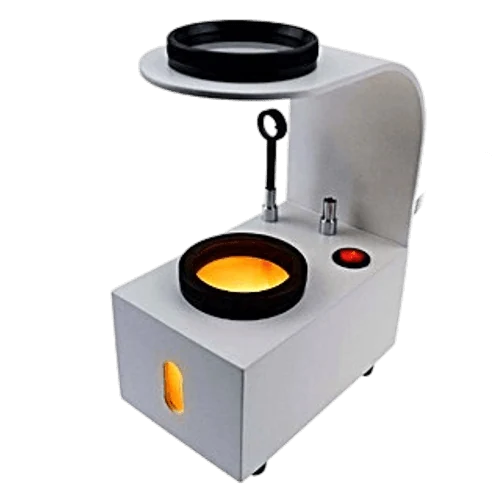 The polariscope: a light source below, two polarising filters, and the stone between them.
The instrument is two polarising filters and a light source. The gem sits between the filters. You rotate the stone against the crossed filters and watch what the light does. Four patterns cover nearly everything you will meet:
| Pattern as you rotate | Reading | What it tells you |
|---|---|---|
| The stone blinks bright and dark four times | Anisotropic (doubly refractive) | Quartz, corundum, topaz, tourmaline, zircon families, the majority of coloured stones |
| The stone stays dark through the rotation | Isotropic (singly refractive) | Diamond, garnet, spinel, glass, a short list worth its own confirmation |
| Irregular patches, cross or snake shapes | Strain or anomalous behaviour | Typical of glass and some assembled stones; also heat-treated material |
| The stone stays bright | Aggregate (many tiny crystals) | Most jadeite, chalcedony, lapis, stones that are rocks rather than single crystals |
What it cannot do
It reads transparent and translucent stones only. Opaque material gives nothing to interpret. And the reading alone never names a stone: singly refractive still means diamond, garnet, spinel or glass until the refractometer, the loupe and, where money depends on it, a laboratory separate them. Singapore's testing options are profiled in our gem labs guide.
Why gemmologists reach for it early
The test takes seconds, needs no liquid, no contact and no calculation, and it splits the mineral families immediately. In the professional sequence, loupe, refractometer, specific gravity, then the polariscope, it is the fast sorter for whatever survives the numbers. Students meet it in the first instrument sessions at JDMIS because interpreting the four patterns trains the habit every later test depends on: reading a signal, then asking what could fake it.
Learn it hands-on
- GT200 Gem Identification Methods: the instrument sequence on real stones, polariscope included.
- All eight identification tools: what each one measures and who realistically needs it.
- The dichroscope, explained: pleochroism, the ruby-vs-spinel sorter.
- The UV lamp, explained: fluorescence screening for synthetics, dyes and fillers.
- The specific gravity kit, explained: density, the reading look-alikes cannot fake.
- How to identify gemstones: the full workflow, from loupe to laboratory.
- Gem materials index: properties for 83 materials, the list the readings get checked against.
Learn this properly, gemmology at JDMIS, Singapore
Everything on this page is taught hands-on at JDMIS with real stones:
- Gemmology: Secrets of the Gem & Jewellery Trade (GT100): polariscope readings are one of the first instrument habits GT100 builds
- Gem Identification Methods (GT200): hands-on instrument work: refractometer, specific gravity, microscope and UV, the way professionals actually identify stones.
Free tools while you read: Gem Globe (where stones come from) · Name That Gem (test your eye) · our guide to every Singapore gem laboratory.
Educational content by the gemmology faculty of the Jewellery Design & Management International School (JDMIS), Singapore. Gemmological constants quoted are standard reference values.